
The Intelligence Community’s Missing Link
The Wisdom of CrowdsThis thread traces the shift from calls for centralized intelligence to a diagnosis that fragmented agencies lacked effective information aggregation.
increasing Bearing strength in each event
 decreasing
Bearing strength in each eventdecreasingDonovan’s Appeal

A Case for Central Intelligence
Lessons of Pearl Harbor
Wild Bill Donovan argued that the United States needed a centralized, impartial, independent intelligence agency. Divided responsibilities had failed to bring warning signs together before the attack on Pearl Harbor.
The approaching Cold War and new weapons, he argued, made a more comprehensive intelligence effort essential. The proposed solution was unity of command and a common intelligence structure.
The Founding Vision
Congress passed the National Security Act in 1947 and created the Central Intelligence Agency. The institution was intended to address fragmentation by placing intelligence under a central framework.
The later story tests whether centralization, by itself, could solve the deeper problem of making dispersed information useful.
A Fragmented System
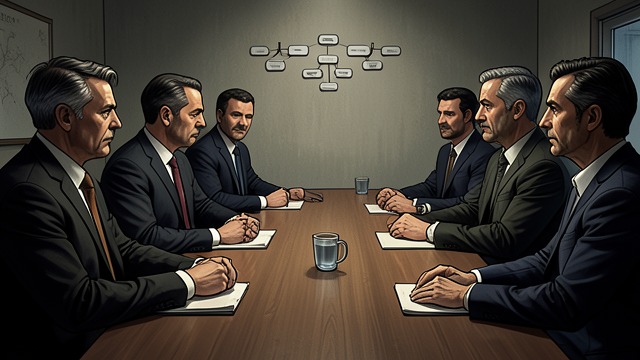
Agencies Without a Common Picture
Specialized Institutions
The intelligence community grew into a collection of agencies with overlapping responsibilities and different missions. The CIA director had limited power over much of this system, while the Department of Defense controlled much of its funding.
The FBI operated largely outside the intelligence community despite information that could bear on foreign threats within the United States. The result was specialization without reliable unity.
Local Snapshots
This structure preserved agency expertise and local knowledge, but it did not ensure that one agency’s findings reached others or acquired wider meaning.
The problem was not simply that many institutions existed. It was that their separate judgments lacked a dependable route into a collective assessment.
Warnings Not Combined

Repeated Missed Opportunities
Attacks and Signals
The intelligence community failed to anticipate the 1993 World Trade Center bombing, the 1998 embassy bombings in Kenya, the USS Cole bombing, and the September 11 attacks.
Afterward, investigators identified information that appeared significant in retrospect. That does not prove that officials could have recognized each clue in advance amid the volume and ambiguity of intelligence.
A Process Question
The failure nevertheless prompted a question beyond hindsight: could better procedures have helped analysts recognize relationships among information held by separate agencies?
The inquiry shifts attention from individual foresight to organization, asking whether a fragmented system can see patterns that none of its parts can see alone.
Centralization Reconsidered

One Center or Many Voices
The Case for Command
Richard Shelby argued that the FBI’s decentralized structure had left information fragmented into independent fiefdoms. He called for a stronger central authority able to gather and evaluate intelligence across agencies.
The proposal answered an evident problem: information that remains trapped in separate systems cannot contribute to a shared warning.
The Cost of a Single Lens
The book recognizes the need for sharing but warns that a small central group may discard diverse perspectives and local expertise. Putting all intelligence in one place does not automatically make its interpretation wise.
The debate turns on a distinction central to the book: aggregation can unify knowledge without requiring every judgment to be made by a central planner.
Aggregation Instead of Command

A Different Reform
Connect the Evidence
The author argues that the intelligence community’s central deficit was a lack of mechanisms for aggregating information and judgments. Linked databases and shared watch lists could have helped agencies make connections without erasing their distinct roles.
Prediction markets offered a more ambitious possibility: analysts from different institutions could register probabilistic judgments without tailoring them to office politics.
A Conditional Resolution
The argument does not claim that markets or databases would certainly have prevented an attack. It proposes that the system could have become better at recognizing collective significance.
The thread resolves against both extremes: fragmentation without aggregation wastes knowledge, while centralization can discard the diversity that makes knowledge valuable.
April 1946
Postwar decades before September 2001
1993 to September 2001
The Congressional review after September 2001
The chapter 4 conclusion, two years after September 2001
